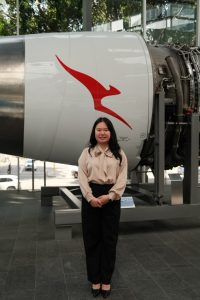
Linda Feng, Coordinator Training Scheduling at Qantas Airways
What is your Job?
Our team manages Tech Crew Training Scheduling, from initial planning through to day-of-operations disruptions. As a Coordinator, I focus specifically on managing those disruptions as they arise. At Qantas, most training is conducted in-house, including instructor training, aircraft conversion and promotion training, and recurrent training. We are responsible for planning both training programs and instructor rosters across Ground School, Flight Training Devices, Full Flight Simulators, and Line Training. Stakeholder management is also a key part of the role. We work closely with Flight Operations, Training Managers, Resource Planning, and the Integrated Operations Centre (IOC). Our communication extends well beyond pilots and trainees; we collaborate with a wide range of operational teams to keep training running smoothly.
What does a normal day look like for you?
No two days are the same. While we have core daily tasks to complete, the nature of the disruptions we manage is constantly changing. One day, a simulator may be AOG due to a power outage. The next, thunderstorms might impact flights in and out of Sydney, Brisbane, or Melbourne, affecting trainees and instructors positioned in those ports. That unpredictability is what makes the role so dynamic, fast-paced, and exciting.
Crazy story from work?
In my first few weeks on the job, the A380 was approved to operate short sectors to help meet high line training demand. These flights would take off, reach top of climb, then turn around and return to Sydney – essentially purpose-built training sectors. I was lucky enough to be offered the jump seat on one of these flights. On departure out of Sydney, we were treated to a harbour scenic, which was an unforgettable experience, especially so early in my career. Sitting on the flight deck of an A380 and seeing Sydney Harbour from that perspective was a surreal moment I’ll never forget.
What is your favourite part of the job?
One of the most rewarding parts of the role is seeing trainees successfully complete their training and check out of the system. Conversion and promotion training is demanding; many trainees commit three to four months full-time, often while balancing family responsibilities. Supporting them through disruptions and challenges, then seeing them reach that milestone, is incredibly fulfilling.
How did you get to where you are today?
I moved to Australia when I was 10 years old. I still remember boarding the flight from Taipei to Sydney and looking at the flight attendants in awe; at the time, I thought that was what I wanted to do. Like many childhood dreams, that aspiration evolved. Although I didn’t pursue that particular path, my fascination with aviation never faded. When I discovered UNSW’s Aviation Management degree, I quickly withdrew from my original university offer and committed to that path. I haven’t looked back since.
What qualifications do you need to apply for your job?
A university degree is strongly recommended. Much of our work involves compliance with aviation laws, regulations, and internal policies. This includes ensuring we meet rest requirements, instructor qualification standards, and the conditions outlined in the pilots’ Enterprise Agreement. Attention to detail and regulatory awareness are critical in this role.
What character qualities do you think suit this position?
Strong interpersonal skills are essential. We communicate daily with pilots, IOC, flight operations, and a range of other stakeholders. Equally important is adaptability and the ability to manage complexity. Situations can change rapidly, and you need to pivot quickly without dwelling on setbacks. Resilience and composure under pressure are key.
What is involved in the training for your job or for the qualification you gained to get your job?
Beyond my university degree, the part-time and full-time roles I held during and after my studies were instrumental in helping me secure my current position. Those roles helped me build transferable skills such as project management, communication, decision-making, and stakeholder management. Early career experiences are incredibly character-building and often lay the foundation for bigger opportunities.
If you could go back and give your younger self some advice, what would it be?
I’ve always been ambitious and have often felt frustrated that my career wasn’t progressing quickly enough. With hindsight, I would tell myself to be patient. Every role teaches you something valuable, and each experience builds the skillset that prepares you for the next opportunity.
What advice would you give younger girls wanting to start a career in Aviation?
Aviation is a small but incredibly diverse industry. There is a niche suited to every personality type, so don’t limit yourself to one pathway. I’ve seen young women achieve their dream roles only to realise they weren’t what they expected, while others have discovered unexpected roles they ended up loving. Be open-minded and willing to explore different opportunities. Aviation can surprise you.
Do you have anything else you would like to share?
Don’t underestimate the value of your existing skills. I often hear young women say, “I just work in hospitality” or “I just work in retail.” Those experiences build foundational skills – communication, resilience, problem-solving, and teamwork – that are highly transferable and incredibly valuable. Never undersell yourself.