STEPHANIE Crafford, Pilot at Hardy Aviation
What is your Job?
I work as a charter pilot for a general aviation operator in the Northern Territory called Hardy Aviation. We fly light aircraft from Darwin to remote locations across Northern Australia. We fly primarily to small communities in the NT. These towns are often very difficult to get to by road and some are even inaccessible by car when it floods for several months throughout the year. Due to this we fly a lot of healthcare workers and tradesmen who play important parts in keeping communities running. In this role I fly Cessna Caravans and Cessna 400 series aircraft which can take up to 14 people.
What does a normal day look like for you?
I would break up my days into 3 stages; preparation, flying and packing up.
Preparation:
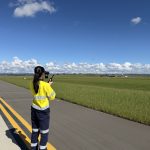
The first thing I do when I get to work is check the weather, plan my flight and order fuel for my aircraft. During the summer months in the NT we can experience widespread rain and thunderstorms, so it can be very important to pay close attention to the forecasts and airport notifications. I then conduct a daily inspection on the aeroplane to ensure everything is in working order and it is safe to fly.
Next, I check in my passengers. The weight and the location of the centre of gravity is especially important for small aircraft, so each passenger and their bags have to be weighed individually. I then load their bags and give the passengers a safety brief.
Flying:
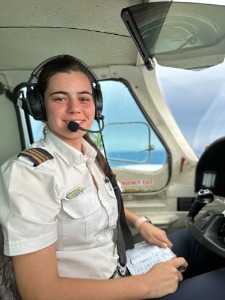
This is my favourite part! I start up my aircraft, taxi it out to the runway and fly to our destination. Once we’ve landed and shutdown, I will help passengers deboard and unload their bags. Depending on my schedule for the day, I’ll either fly home or pick up new passengers for another trip elsewhere.
Pack-up:
Once I’ve landed back home, it’s time to pack up the aircraft. Due to Darwin being a cyclone area, it’s very important that we tie down the aircraft and put the covers on at the end of each day. After walking back to the office, I’ll have to fill out some paperwork and my logbook.
We’re then assigned flights for the following day at the end of the current day.
What is your favourite part of the job?
We travel to very remote towns and communities that sometimes have very small populations. It feels very special to be able see these places and experience the culture as not many people have the chance to do so.
Also the view while flying!
How did you get to where you are today?
When I was in primary school, I moved from South Africa to Australia. When we used to visit my family, I really enjoyed flying and this is what inspired me to become a pilot.
Once I had finished high school, I started my flight training and Bachelor of Aviation. After that I moved to the Northern Territory where I initially started working as an operations manager for a charter company in Katherine. In this role I worked in a small team to help schedule flights and maintenance. After a few months I started flying their 6 seater aircraft as a charter pilot.
My next job is my current job where I get to fly more complex aircraft.
What qualifications do you need to apply for your job?
You will need to complete your Commercial Pilot’s License at a flight training school, however there are a few additional flying qualifications that you can also complete to help you stand out when you apply for your first job.
Some universities offer aviation related degrees, however they are not strictly necessary to be employed as a pilot.
What character qualities do you think suit this position?
Strong decision making skills are good quality to have as a pilot. We can learn a lot from our previous experiences and it’s important to apply that knowledge to future situations.
I’d also say resilience, adaptability, communication skills and a positive attitude will help you to succeed in the industry.
What is involved in the training for your job or for the qualification you gained to get your job?
In flight school we usually do about 200 hours of flying training. About half of this is hour-building where you get to go on longer flights a bit further away by yourself. We also have a few exams that cover a range of theory about aeroplane systems, weather, human behaviour and regulations.
When you start working, you will need to learn the company’s flying procedures. Initially you will first go on a few observational flights with other pilots to see what their procedures are like. Then you will fly the aircraft yourself with a supervisory pilot. Once you are proficient, you will go for a check flight after which you can start flying by yourself. Every 6 months, you conduct another check flight to ensure you are at the same standard and are following procedures correctly.
If the company you work for has different types of aircraft, you repeat this process for each new one that you start flying.
If you could go back and give your younger self some advice, what would it be?
Enjoy the journey! Sometimes we can get so focused on an end goal we forget to enjoy the process of learning new things and gaining life experience.
What advice would you give younger girls wanting to start a career in Aviation?
Take every opportunity that you are given, there is so much to experience and enjoy in the industry.
Aviation is full of lots of wonderful people, don’t be afraid to talk to as many of them as you can and ask heaps of questions. There will always be someone willing to help you along the way.
Do you have anything else you would like to share?
When we think of pilots we normally think of big international jets. These are awesome roles but there are also so many types of flying that offer different experiences. For example, agriculture, float planes, corporate, instructing, fire spotting, military and many more. I would really encourage anyone considering a career in aviation, especially as a pilot, to explore these avenues.